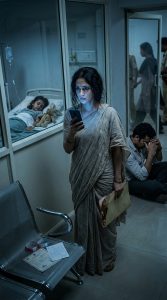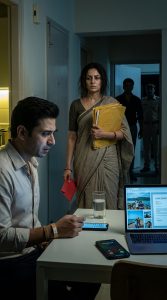
“…Dr. Aarav Dev Mehta.”

“…Dr. Aarav Dev Mehta.” The name fell from Mahendra Malhotra’s mouth like a secret escaping...

His voice was pale.

His voice was pale. Not angry yet. Not ashamed. Pale. Like a child who had...
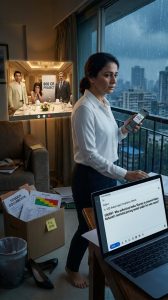
from Legal. **URGENT: Who authorized Anika Sharma to present Naina Kulkarni’s restricted pricing model under her own name?** The line glowed on my screen like a match held near dry petrol. On the call, nobody spoke. Not Raghav. Not the CEO. Not Anika, whose bravery had suddenly gone quiet. I could hear only the hotel noise behind them—the clinking of cutlery, the low hum of expensive air-conditioning, the distant laughter of people who did not yet know the celebration dinner had become a funeral. Then another ping. Another. Another. My email was opening across the company like fire moving through curtains. The CEO’s voice came back slowly. “Ms. Kulkarni, stay on the line.” “No,” I said. Raghav panicked. “Naina, please. Don’t disconnect.” “You disconnected me from the company at 10:12 a.m.” “That was HR.” “You are HR when you want to fire. You are management when you want credit. You are helpless only when caught.” Silence. Then Anika’s voice cut in, shaky but still sharp. “Ma’am, please don’t act like you are innocent. You never shared the final file with me.” I almost admired her. The ship was sinking, and she was still blaming the carpenter. “I shared it,” I said. “You deleted the red notes.” She went silent. Raghav whispered, “Anika…” I opened another folder on my laptop. Version history. There it was. **Restricted_Model_Final_NK_v12.xlsx** Edited by: Anika Sharma. Timestamp: 2:43 a.m., last Thursday. Risk notes hidden. Clause 14.3 warning removed. Liability cap changed from capped exposure to uncapped pass-through. A single cell. One number. One missing footnote. That was all it took to turn an ₹800 crore project into a legal grenade. “Check your inbox,” I said. Another wave of pings came from their side. Someone gasped. The CEO cursed under his breath. Not loudly. Not like a man losing temper. Like a man watching handcuffs form in the air. “Naina,” he said, no longer calling me Ms. Kulkarni, “why did you wait to send this?” The question made me laugh. Softly. Dangerously. “I sent warnings for three months. Raghav marked them ‘noted.’ Legal ignored them. Finance said I was delaying commercial closure. Anika called my risk note ‘negative thinking.’ You want to know why I sent this tonight? Because this afternoon your HR called me redundant, and suddenly my silence also became redundant.” Raghav breathed my name like a prayer. “Naina…” I looked at the dark window in front of me. My own reflection stared back—loose hair, old T-shirt, no blazer, no heels, no employee badge hanging around my neck like a dog tag. For the first time in years, I looked tired. But not small. “Don’t call me again tonight,” I said. The CEO spoke sharply. “Ms. Kulkarni, if you disconnect, we will consider this refusal to cooperate.” I smiled. “You already terminated me. Cooperation ended with employment.” Then I cut the call. My hands were not shaking. That surprised me. For four years, Raghav had made me believe my anger was unprofessional. That my boundaries were attitude. That my exhaustion was weakness. But sitting in my Dadar flat with prawn chutney on one plate and an ₹800 crore corpse on another screen, I understood something. They had never feared my incompetence. They feared what would happen when I stopped saving them from their own. I opened Mr. Iyer’s message again. **Are you available tomorrow at 9 a.m. to discuss joining us as independent consultant?** I typed. **Yes. But only if the discussion includes why your team accepted a celebration before legal review.** Three dots appeared. Disappeared. Then: **Fair. I expected that answer.** I leaned back. For one small second, I almost smiled. Then my main phone rang again. This time it was not Raghav. It was Priyanka from HR. The woman who had fired me like reading weather. I answered. “Ms. Kulkarni,” she said, voice trembling now, “there has been an administrative error.” I closed my eyes. Morning: market slowdown. Night: administrative error. Corporate language had more costumes than a mythological TV serial. “What error?” “Your termination letter was not meant to be processed today.” “Interesting. Was it meant to be processed after I saved the tender?” She swallowed. “I was instructed to call you.” “By whom?” Silence. “Priyanka,” I said, “you fired me this morning with a script. Speak without one now.” Her voice broke a little. “Raghav sir sent the list last night. Your name was marked urgent. He said you were becoming difficult and that Anika could take over.” There it was. Not slowdown. Not redundancy. Punishment. I had questioned the number. I had questioned the shortcut. I had questioned why Anika was being copied on files above her level. So they removed the question. “Send me that email,” I said. “I can’t.” “You can. You won’t.” She whispered, “I have a child, ma’am.” I looked at the ceiling. Everyone had someone to protect. And somehow women like me were always expected to be the shield. “Then protect yourself properly,” I said. “Forward it from a personal device. Or prepare to explain why you executed a targeted termination forty minutes before a bid submission.” She began crying. “I didn’t know it was like this.” “You didn’t need to know. You needed to ask.” I hung up. Ten minutes later, the email came. Anonymous address. No subject. Attached screenshot. From: Raghav Malhotra. To: Priyanka HR. **Process Naina Kulkarni exit before noon. Disable official access by 6 p.m. Do not inform team until after bid presentation. Reason: role redundancy. No discussion.** Below that, another line: **Anika Sharma will represent proposal ownership going forward.** Proposal ownership. My work had not even been stolen quietly. It had been reassigned while still warm. I forwarded the screenshot to myself, my lawyer friend, and one old Gmail account I had made in college and never used. Then I shut the laptop. The flat became too quiet. Anger is loud while fighting. Afterwards, silence comes with all the wounds you postponed. I went to the bathroom and washed my face. There were dark circles under my eyes. A tiny burn mark on my wrist from office machine coffee three months ago. A scar near my thumb from the night I cut fruit at 2 a.m. while reviewing subcontractor pricing. My body had kept accounts even when I had not. At 11:38 p.m., the doorbell rang. I froze. Nobody came to my flat unannounced. I looked through the peephole. Anika stood outside. No champagne now. No victory smile. Her makeup had run. Her hair was loose. She was holding a file against her chest as if someone might snatch it. I did not open immediately. She looked up at the peephole. “Ma’am,” she whispered. “Please. I know you’re inside.” I opened the door with the chain still on. “What do you want?” She looked smaller than she had in the photos. Younger. Twenty-four, maybe twenty-five. Too young to know that ambition without spine becomes a leash in someone else’s hand. “I need to talk.” “I don’t.” Her eyes filled. “Raghav sir is blaming everything on me.” I laughed once. “Of course he is.” “He said I changed the model without permission.” “You did.” Her face crumpled. “He told me to.” The corridor light flickered above us. For a second, the anger in me shifted. Not vanished. Shifted. “Do you have proof?” She hesitated. That hesitation answered. “You came here because you don’t.” “I have voice notes,” she said quickly. “Not all. Some. He used to call late at night. He said if I wanted to grow, I had to be bold. He said you were old thinking. He said the company needed loyalty, not fear.” I looked at her carefully. “And you believed him.” She looked down. “I wanted to.” There are confessions that are apologies. And there are confessions that are only fear wearing apology’s clothes. I did not yet know which one hers was. “Why are you really here?” She swallowed. “Because Raghav sir said if the board asks, I should say you gave me the file and told me to present that number.” My body went cold. She continued, words spilling now. “He said you were bitter because you were being removed. He said you sabotaged the tender. He said if I cooperate, he will protect me.” “And if you don’t?” “He has messages,” she whispered. “Photos. Not like that. But late dinners. Hotel lobby. He made sure people saw us. He said my reputation will finish before my career starts.” For a moment, I saw the pattern clearly. Raghav had not just used my labour. He had used her hunger. My experience made him money. Her ambition made her obedient. And when the project broke, both women were ready-made dustbins for his sin. I opened the chain. “Come in.” Anika stepped inside like she was entering a police station. She saw the cardboard box near the door. The donation bag. The trash full of old office things. Her eyes filled again. “You really left.” “No,” I said. “I was thrown out. I only stopped crawling back.” She sat at my dining table and opened her file. Inside were printed chats. Voice note transcripts. A handwritten page from Raghav. **Don’t worry about Naina’s caution. Client wants aggressive pricing. Hide the exposure note. I will handle board.** My pulse slowed. This was no longer just revenge. This was evidence. “Why didn’t you send this earlier?” I asked. She wiped her nose with the back of her hand. “Because I thought if I stayed loyal, he would choose me.” The answer was ugly. Honest. Human. I looked at the girl who had tagged me in a celebration post two hours earlier. A part of me wanted to punish her. To let her learn the full price of stealing another woman’s chair. But another part of me, older and tired, recognized the trap. Women are made to fight for chairs at tables built by men who remove the floor. I took the papers. “I am not saving you.” She nodded quickly. “I know.” “I am saving the truth.” Her face crumpled. “I know.” My phone rang again. This time, the name on the screen made both of us go still. **Raghav Malhotra.** I put it on speaker. Neither of us spoke. Raghav’s voice came through, strained and low. “Naina, listen carefully. Anika is missing from the hotel. If she contacts you, do not believe her.” Anika’s face turned white. I looked at her. She shook her head silently. Raghav continued. “She is unstable. She is trying to protect herself. She may forge documents. She may say I instructed her. Do not get involved.” I picked up a pen and wrote on a pad. **Recording?** Anika nodded and opened her phone recorder. I spoke calmly. “Why would she say you instructed her?” Silence. Then Raghav laughed softly. “You are clever.” “No. Just redundant.” His breathing changed. “Naina, don’t start a war you cannot finish.” “There was an ₹800 crore war in my laptop bag this morning. You fired the soldier carrying it.” “You think the board will choose you over me?” “I think the board will choose survival.” His voice dropped. “You have no idea what survival costs.” That sentence landed strangely. Not like a threat. Like a warning from a man who had received one first. Before I could answer, he said, “This tender was not supposed to win on merit. Clause 14.3 was supposed to fail later.” I sat up slowly. Anika’s eyes widened. “What does that mean?” I asked. Raghav was silent too long. Then he said, almost whispering, “Why do you think they fired you before presentation?” My skin turned cold. Outside, a train passed somewhere in the distance. The window glass trembled. “Who is they?” No answer. “Raghav.” His voice returned, broken now. “I thought I could control it. I thought if Anika presented, nobody would ask the hard questions. The client would sign. Later, the liability would trigger. Insurance. Arbitration. Political cover. Everyone would get paid.” My mouth went dry. “You were setting up a failure?” “Not me alone.” “Names.” He laughed bitterly. “You think I’m calling to confess? I’m calling because now everyone thinks I failed them.” Anika whispered, “Sir…” Raghav stopped breathing. Then, very softly, he said, “She’s there?” I looked at Anika. She looked terrified. “Yes,” I said. His voice changed instantly. “Anika, come back to the hotel.” She shook her head, though he could not see. “No, sir.” “Don’t be stupid. You don’t know what Naina will do.” For the first time, Anika spoke with something stronger than fear. “I know what you did.” Silence. Then Raghav said, “Then you also know you signed the final submission.” She closed her eyes. He continued, cruel now. “You wanted young blood responsibility, remember?” Her mouth trembled. I took the phone. “Raghav, send me the names.” He laughed. “And then? You become whistleblower queen? You think they will let you walk away?” The word they grew teeth. Before I could ask again, a loud sound came through his side. A chair scraping. Someone shouting his name. Then Raghav whispered one sentence that made my blood turn to ice. “Naina, do not go to Mr. Iyer tomorrow. He is not the client you think he is.” The call cut. Anika and I stared at the phone. Then, almost immediately, my screen lit up with a message from Mr. Iyer. **Change of plan. Meet tonight. 1:30 a.m. Sea Link service road. Come alone. Bring original model files.** I looked at the time. 12:06 a.m. Anika began shaking. “Ma’am, please don’t go.” I opened my laptop again. The old tender folder waited on the screen. One year of my life. ₹800 crore. A cancelled bid. A staged failure. A boss suddenly afraid. A client who wanted to meet on a dark road at 1:30 in the morning. And somewhere between the version history and Clause 14.3, I realized I had not escaped a toxic company. I had walked out carrying proof of something much bigger. At 12:11, another message came. Unknown number. **Your father’s hospital bill was paid by Malhotra Infrastructure last year. Ask why before you trust your own anger.** My hands went numb. My father’s surgery follow-up. The one I had missed. The bill I thought insurance finally cleared. I stood so suddenly the chair fell back. Anika whispered, “What happened?” I could not answer. Because the company I thought had stolen only my work may have touched my family too. And revenge, which had tasted sweet an hour ago, suddenly tasted like blood. I looked at the laptop. At Anika. At the message from Mr. Iyer. Then at the cardboard box by the door, where Clause 14.3 lay printed in red ink like a warning no one wanted to read. By morning, someone would call me a fired employee. Someone would call me a saboteur. Someone would call me dangerous. But before sunrise, I was going to find out why an ₹800 crore tender needed a woman like me removed, a girl like Anika blamed, and my father’s hospital bill quietly paid. So tell me—if the job that destroyed you was hiding the truth that could destroy everyone above you, would you walk away free… or go back into the fire carrying the one file they forgot could burn them all?

from Legal. **URGENT: Who authorized Anika Sharma to present Naina Kulkarni’s restricted pricing model under...

“That report is wrong,” Shalini whispered, “just like her birth certificate.”

“That report is wrong,” Shalini whispered, “just like her birth certificate.” For one second, nobody...

The room stopped breathing.

“Maa, if you are watching this, it means they finally did what they were planning…”...

My daughter said her tooth hurt, and my husband suddenly insisted on taking us to the dentist

For one second, the room forgot how to breathe. Even the police officer stopped halfway...

I froze behind Papa’s grave, the yellow envelope trembling in my hand.

I froze behind Papa’s grave, the yellow envelope trembling in my hand. Vikram’s voice came...

My husband spent fifteen days in Goa with his “best friend” and came back thinking I would only cry

I opened the door. A man stood outside in a navy shirt, wet hair combed...
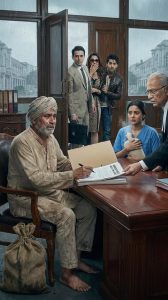
I sold my village land for ₹200 crore and came to Delhi dressed like a

than disinheritance. It said: **All three biological children are to be legally barred from accessing,...